Optimizing Customer Service:
A Desktop Solution for Booking.com Agents

Project Overview
Background :
As Booking.com began migrating customer service functions from its legacy CRM to PEGA (low-code platform that uses AI and automation to help businesses build applications, streamline complex processes, and manage customer experiences.)
The new Reservation Timeline, redefines how agents view and manage customer interactions and events in PEGA. By providing a consolidated overview, we enable a more efficient workflow and ultimately a better experience for our users.
My role:
I owned the end-to-end experience design from researching agent pain points to restructuring the agent desktop and designing the timeline.
-
End-to-end wireframing : the full journey across agent and guest sides
-
Prototyping : built the prototypes used for testing
-
Research : moderated sessions with CS agents
-
Cross-functional collaboration : with Process, Product, UX writing, and CS agents
90%
End-to-end completion of cases within Single system (PEGA)
30%
Reduction in CS agents needing to move the case to Legacy system
Unlocking User Needs
Focus group:
The goal was to uncover their primary pain points with the existing PEGA reservation timeline, to understand their mental model for managing reservations, and to determine why they still relied on the legacy system.
-
Participants: We recruited 7 Customer service agents with varying levels of experience (from 6 months to 10+ years). All participants had experience managing complex, multi-party reservations.
-
Moderator's Guide: Our guide was structured around open-ended questions designed to encourage discussion.
Key topics included:-
Their daily workflow for handling a new call.
-
What information they need at a glance.
-
Frustrations with the current system's data presentation.
-
-
Logistics: The session was conducted virtually with a single moderator and two note-takers.

Focus group feedbacks from customer service
Affinity Mapping & Requirement Synthesis
Stakeholder collaboration :
We held a collaborative workshop with stakeholders from Process Design, Knowledge Management, Customer Service, and Product Management. Our goal was to analyze the raw research data, use affinity mapping to group it, and assign key themes.
In the second part of the session, we split into groups to collaboratively write 'AGENT MUST BE ABLE TO --' statements, defining the actions agents needed to perform.

Design, Prototype , Iterate
The agent desktop anatomy before redesign :

1
Left panel Underused: a whole column for just a timer and one button. a permanent space the reservation could use.
2
Header : Wasted vertical space pushes the content that matters below the fold.
3
Detail grid — Four columns, every field the same weight — no hierarchy, so the agent scans everything to find one thing.
4
History — Split across three tables (cases, comms, TED tickets) from two systems : different columns, different status labels, details hidden behind clicks. The agent can't see one coherent story.
SUMMARY:
The agent console holds everything but organises nothing so answering one question means hunting across a flat detail grid and three fragmented history tables, or giving up and switching to the legacy system.
Designing the timeline meant redesigning around it.
To give it a proper place, I restructured the layout and reworked the information architecture, deciding what surfaces first, what collapses, and where the timeline anchors the agent's attention.
Because this is an internal agent desktop, all of it had to work within two systems at once: PEGA's design guidelines and Booking.com's design language. So the challenge wasn't just designing a timeline — it was integrating new IA into an existing, constrained system without breaking either.
Idea I : Adjust the new timeline in the existing layout
.png)
Idea II : New vertical layout customer 360
.png)
Idea I : Adjust the new timeline in the existing layout
One timeline for the whole reservation story
Emails, notes, and cases unified into a single chronological view — scan it collapsed, open any row to read in place.

A SCANNABLE OVERVIEW
every event surfaced newest-first, so the agent parses the full history pre-attentively, without drilling in.
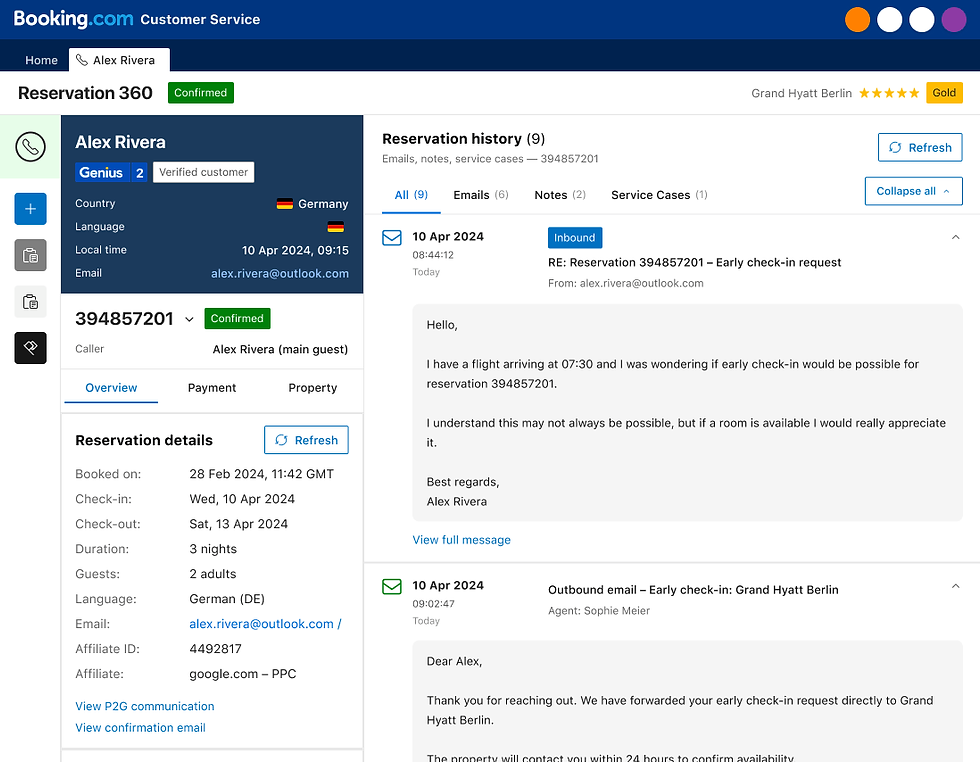
PROGRESSIVE DISCLOSURE
the agent opens a single row to reveal the full message in context, keeping them in flow rather than navigating away.


Final design:
Project Success & Path Forward
Since the implementation A survey of trial agents during the rollout phase reported a "positive reception" to the new Customer Service Timeline.
Agents noted improvements such as clearer case visibility, faster updates, better organization, and increased efficiency when accessing reservation history and case information.
Current Focus Areas (Iteration):
-
Improving hyperlink visibility.
-
Ensuring inbound emails display within the primary widget (eliminating the new widget pop-up).
-
Developing a feature for displaying all attachments in a single, consolidated view.
Let's talk.
Tel. +31 644 14 2251
Gmail : schtnbiswas@gmail.com
Let's talk.
Tel. +31 644 14 2251
Gmail : schtnbiswas@gmail.com