Empowering Agents: Replacing Automated Assignment with an Intentional Picklist

Project Overview
With almost 60% of inbound communications arriving while the Booking Customer Service team is offline, agents were frequently overwhelmed by a massive, disorganized backlog. I designed and optimized the Picklist work distribution experience—shifting from a rigid 'push' model to an autonomous 'pull' model. This strategic redesign directly reduced Average Handling Time (AHT) and increased agent satisfaction by replacing randomized task allocation with a prioritized, high-context selection process.
Understanding pain point
I shadowed agents for a full day to see where they get stuck. The biggest issue? Random tasks hitting their queue at the wrong time. These cards show the main patterns I found.
Uncovering the Real Pain Points
System reliability
Agents clicked on button to get work item, they waited up to several minutes, only to see a technical failure banner .
Lack of trust
Agents were working significantly delayed contacts under a “most urgent” label.
Duplicate effort
Agents receives work items that had already been resolved/completed earlier
Productivity Gap
Agents are forced to leave the platform during wait periods because the system doesn't allow for parallel tasking.
In my research, I found two types of problems. Some are engineering team need to fix and automate, but many are actually 'Design Gaps.' These are places where we can help agents stay in their flow just by changing how we handle waiting periods and how we show them their priorities.
JOBS TO BE DONE
When my current task is stuck in a waiting period, I want the ability to switch to a new task without losing my handling time.
JOBS TO BE DONE
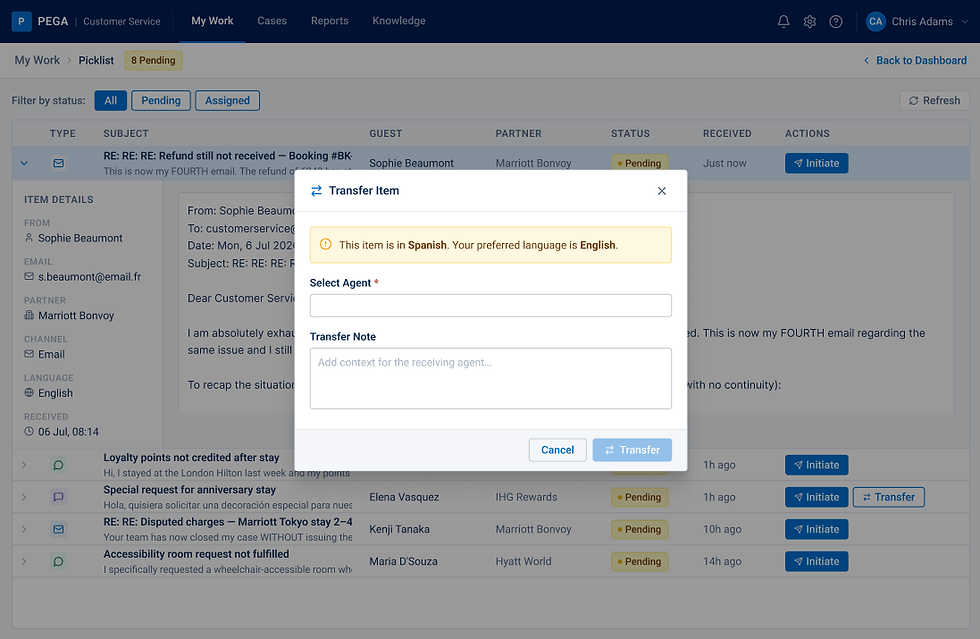
When I am organizing my picklist, I want to assign tasks to another specialist without actually 'starting' the work and not damaging my productivity KPIs.
In my research, I found two types of problems. Some are engineering team need to fix and automate, but many are actually 'Design Gaps.' These are places where we can help agents stay in their flow just by changing how we handle waiting periods and how we show them their priorities.
JOBS TO BE DONE
When my current task is stuck in a waiting period, I want the ability to switch to a new task without losing my handling time.
JOBS TO BE DONE
When I am organizing my picklist, I want to assign tasks to another specialist without actually 'starting' the work and not damaging my productivity KPIs.
Shaping the Solution
Key design decisions:

Context before commitment :
Expanding a task reveals topic, language, and a full message preview so agents make informed picks, not blind ones.
Urgency at a glance :
Orange "Urgent" tags surface priority tasks immediately without cluttering the interface.
Status visibility :
Green "Picked" badges prevent duplicate handling across the team.
Progressive disclosure :
Detail is hidden until needed, keeping the list clean and scannable.
Skip and Reassign :
Gives agents a graceful exit if a task isn't the right fit, assign it to the right skill without dropping it.

Impact & Feedback
Adopted by everyone
The feature has improved 32% of average handling time (AHT). It was initially scoped for senior agents only , but adoption was so strong and intuitive that the business decided to roll it out to the entire agent population.
What's next
The design succeeded in giving agents control, but surfaced a new challeng task status accuracy in multi-agent environments. Resolving this required routing logic beyond the current build scope, and remains an open opportunity for the next iteration.